The Future of Efficiency: 5 Pillars of Operational Excellence in 2026
- Feb 12
- 4 min read
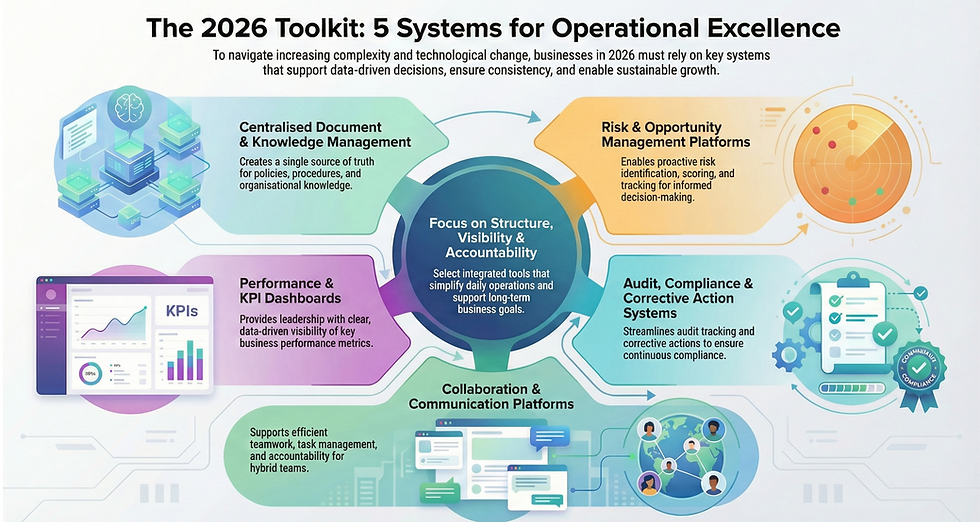
As we navigate the landscape of 2026, the modern enterprise is caught in a complexity trap. While the volume of available digital tools has exploded, so too has the velocity of regulatory change and the pressure for transparent governance. Success in this high-stakes environment is no longer defined by the sheer size of a tech stack, but by the strategic integration of systems that bolster decision-making, operational consistency and risk resilience. To scale with confidence, leaders must shift from fragmented "tool hoarding" toward a Unified Operating Model—an ecosystem where technology serves as the scaffolding for structure and visibility, rather than a source of organisational noise.
1.Centralised Knowledge Management: Moving Beyond Individual Knowledge to Institutional Intelligence
In 2026, document control has evolved from a back-office administrative function into the very heartbeat of organisational agility. Maintaining a single source of truth for policies, procedures and records is the only way to ensure that execution remains consistent across a distributed workforce. By centralising these assets, an organisation effectively de-risks its most volatile asset human capital.
When institutional intelligence is locked within the minds of individual staff members, the organisation suffers from significant "key person risk." This transition to a centralised system ensures that critical knowledge survives personnel turnover and shifts in the labour market. From a strategic standpoint, this centralisation accelerates the velocity of decision-making, as teams no longer waste cycles hunting for the "latest version" of a process.
"A centralised document management system ensures version control, access permissions and audit readiness while reducing reliance on individual knowledge holders."
2.Risk and Opportunity Management: Establishing Risk-Based Thinking as a Strategic Baseline
Risk management is no longer a seasonal compliance exercise it is a mandatory strategic baseline for high-performing organisations. Modern platforms that facilitate the identification, scoring and tracking of both risks and opportunities allow leadership to move beyond reactive firefighting into a posture of proactive resilience.
For the modern strategist, this shift is about more than safety it is about reducing the "compliance tax" on innovation. By having a real-time view of the risk landscape, organisations can make calculated, data-backed bets rather than operating on intuition. This transforms risk-based thinking into a competitive advantage, allowing the firm to pivot with precision when market disruptions occur, ultimately protecting the P&L from unforeseen volatility.
3.Performance and KPI Dashboards: Achieving High Performance through Real-Time Visibility
The defining feature of 2026 leadership is the rejection of "lagging indicators" in favour of real-time visibility. Performance dashboards that consolidate operational, quality, customer, and financial metrics provide the transparency required to steer a complex organisation through turbulent waters.
When these metrics are aligned with long-term business objectives, they eliminate "decision-making shadows" where inefficiencies often hide. This visibility is the engine of continuous improvement it allows for surgical interventions at the first sign of a metric dipping, preventing minor operational hiccups from cascading into systemic failures. In a high-velocity market, the ability to see and act in real-time is the difference between market leadership and obsolescence.
4.Automated Compliance and Corrective Action: Ending the Cycle of Repeat Findings
The era of manual audit tracking and the recurring frustration of "repeat findings" is over. Forward-thinking organisations have replaced fragmented spreadsheets with digital systems that automate the entire lifecycle of planning, execution and evidence collection. These tools do more than just facilitate audits they close the loop on accountability.
By automating the verification of corrective actions, these systems ensure that a failure identified in January does not reappear in July. This strengthens the organisation’s ability to maintain continuous compliance across multiple international and industry standards simultaneously. From a strategic perspective, this shifts the culture from "checkbox compliance" to radical accountability, where every audit becomes a data point for optimising the broader operating model.
5.Structured Collaboration: Governing Hybrid Communication for Traceability
As hybrid and distributed work models become the permanent standard, the risk of "chaotic collaboration" where decisions are made in siloed chat threads has become a primary threat to margins. The antidote is the adoption of platforms that prioritise structured communication, task assignment and document sharing over simple instant messaging.
Effective collaboration in 2026 is rooted in governance and traceability. By documenting the "why" and "how" behind every task, organisations eliminate the "shadow work" that often leads to duplication of effort and lost audit trails. This structured approach ensures that execution remains consistent across different time zones and geographies, providing a clear map of accountability that is essential for sustainable scaling.
Scaling with Confidence
The core philosophy for the 2026 business leader is one of intentionality tools should provide structure, visibility and accountability, not add layers of friction. These five pillars knowledge management, risk strategy, real-time visibility, automated compliance and structured collaboration do not function in isolation. Instead, they interlock to form a Unified Operating Model that empowers an organisation to manage risk and drive performance simultaneously.
"The key is selecting tools that integrate seamlessly into daily operations and support long-term business objectives."
As you audit your current operational framework, you must ask: Does your tech stack provide a clear, traceable path for sustainable scaling, or is it merely creating noise that masks underlying inefficiencies? The answer to that question will define your organisation's resilience in the years to come.


Comments